



$51 million.
That’s the median nuclear verdict size in 2024, according to research published by Marathon Strategies. And while this number is staggering, the phenomenon of even larger ‘thermonuclear’ verdicts is on the rise.
What are thermonuclear verdicts? These are verdicts against corporations that exceed $100 million—surpassing the $10 million damage award of nuclear verdicts. In 2024, 49 courts issued thermonuclear verdicts in favor of plaintiffs, suggesting that juries are poised to award larger sums in the future.
This trend underscores a significant threat to insurers’ profitability. Insurance carriers seek solutions that address these concerns in tangible ways, as the severity of claims, social inflation, and the growing influence of third-party litigation funding (TPLF) in insurance cases continue to drive award amounts higher.
Telematics data—accessible and readily available to insurers—can profoundly impact their ability to predict and assess risk that could result in a nuclear verdict, driving data-forward underwriting that may lead to profitable growth.
Leverage Data to Empower Underwriting
Insurers underwrite customers based on the expected cost of known risks—location, mileage, business industry, vehicle type, and maintenance, etc. When a nuclear verdict occurs, it introduces unexpected costs that may exceed reasonable compensation (more on that later). These costs drive social inflation and leave insurance companies—particularly those serving commercial fleets—to navigate a complex, evolving risk landscape. From 2013 to 2022, according to the Institute of Legal Reform (ILR), auto accidents involving commercial trucks accounted for the second-highest share of nuclear verdicts (23.2%), suggesting the commercial auto market is susceptible to future nuclear and thermonuclear verdicts.
“1 in 4 auto accident trials that resulted in a verdict of $10 million or more involved a commercial trucking company.”
– Institute of Legal Reform, Nuclear Verdicts Study, pg. 8
During the underwriting process, this data can play a pivotal role by filling information gaps to help identify high-risk outliers. Predictive data can also:
- Enable insurers to build better risk profiles by combining historical and more continuous behavioral driving data, such as telematics.
- Identify patterns and predict the likelihood and severity of claims using vast datasets—allowing insurers to price premiums more accurately.
- Unburden teams with administrative work and streamline data collection to drive efficiency of the underwriting process.
- Reduce premium leakage and underwriting fraud by validating mileage, garaging and areas of operation.
Implementing new data sources can be vital for insurers, enabling a proactive approach to risk mitigation. For example, when an insurer uses telematics data, it can identify high-risk driving behavior before accidents occur. They can work with operators to implement targeted training, reducing accident frequency and severity that may contribute to a nuclear verdict.
Empower Your Underwriters | Create a Plan to Combat Nuclear Verdicts
Predictive data can also help insurers identify fleets outside of their risk appetite who are more likely to be involved in a severe accident. By focusing on low-risk customers, insurance companies can reduce their nuclear verdict exposure and maintain stable pricing.
While this data-led approach can be a powerful tool for underwriters and commercial auto, it doesn’t address the underlying societal shifts contributing to the dramatic rise in nuclear and thermonuclear verdicts.
“Plaintiff’s lawyers have become adept at utilizing the threat of a nuclear verdict to change the landscape of or attempt to change the landscape of the claim.”
– Francine Minervini, SVP of Arch Insurance
Having an awareness of factors driving these jury awards will become crucial for insurers seeking to navigate this landscape outlined by Minervini. The rising severity of car accidents reflects a convergence of forces redefining commercial litigation.
Why Nuclear Verdicts Are Going Viral
No longer a statistical anomaly, there’s a stark reality associated with a nuclear verdict—from monetary impact to reputational risk. Insurance companies can no longer afford (quite literally) to turn a blind eye to the threat of nuclear verdicts.
Why are states like California and Florida virtually tied for states generating the most nuclear verdicts? And why does data indicate a significant upward shift in award levels? Here are some common reasons we’ve seen:
Plaintiff Attorney Strategies
A common, often-heard strategy in nuclear verdicts is the reptile theory. What is the reptile theory? It’s a tactic that appeals to a juror’s instinct to seek safety and security, playing on emotions. An attorney may argue that this company is dangerous to the public; they’re dangerous to the jury.
“The mind is like Velcro for negative experiences, and Teflon for positive ones.”
The reptile theory ignores someone’s ability to make rational decisions and taps into emotional triggers, such as the fight-or-flight response, eliciting a thermonuclear verdict.
Another tactic often seen in these cases is the anchoring effect, a bias described as the human tendency to rely solely on the first piece of information offered. In a nuclear verdict case, an attorney will lead with an extremely high damage amount early in the trial, setting an "anchor" that ultimately influences jurors' judgment and decision-making.
Lastly, in cases where severe injuries or deaths occurred—like commercial auto accidents—attorneys will present and emphasize the plaintiff’s injuries and suffering, evoking strong emotional responses from jurors. This creates a sense of empathy and outrage, contributing to a higher reward amount.
Juror Biases and Perceptions
Jurors, as many of us do, carry their own inherent biases that may contribute to nuclear and thermonuclear verdicts. Outside of emotional decision-making that can sway verdicts, jurors may:
- Have negative perceptions of large corporations that don’t align with their own values or feel they’re held unaccountable for their negative actions.
- Not fully understand the financial implications of a large award on the insurance market, and ultimately, consumer goods or services, driving economic volatility.
- Be influenced by outside media or social networks, which can create negative perceptions of those involved in the case.
Social Inflation and Third-Party Litigation Funding
As a key driver of the surge in nuclear verdicts, social inflation alters the civil litigation landscape, creating an environment in which significant awards are more likely. Think of it this way: a consistent history of nuclear verdicts leads to a higher probability of a similar (or more significant) verdict.
Compounding the issue is the growing use of TPLF in insurance cases, where outside investors finance plaintiff lawsuits in exchange for a share of the award. This dynamic incentivizes longer, more aggressive litigation and inflates settlement demands. When litigation is bankrolled by investors seeking returns, the motivation to settle at reasonable amounts diminishes, pushing a case to trial and increasing the likelihood of a large jury award.
With litigation costs rising, attorneys are incentivized to increase the settlement amount and recoup their costs to generate a profit.
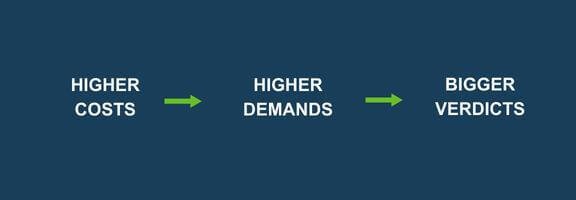
The general rise of economic inflation has increased the cost of medical care and vehicle repairs. The U.S. Centers for Medicare & Medicaid Services (CMS) reports that U.S. healthcare spending grew by more than 7% in 2023, reaching $14,570 per person. These costs are often taken into account when verdicts are determined.
Distracted Driving and Risky Driving Behavior
Speeding, distracted driving, and road rage are becoming a large part of the conversation behind why juries award large verdicts. When a driver engages in reckless actions, it can increase the likelihood of future accidents—fueling massive jury awards.
For example, a Nassau County jury in 2024 reached a thermonuclear verdict of $141.5 million in the case of a logging truck crash that seriously injured three people. The truck driver had a lengthy criminal and traffic violation history, which the hiring company reported as unverified or unchecked.
This example highlights the importance of adopting and using driver data to verify information in a commercial fleet and address the consequences of static (outdated) motor vehicle record (MVR) data, versus leveraging solutions such as continuous MVR monitoring.
Telematics Data and Thermonuclear Verdict Prevention
Beyond the benefits we’ve covered, insurers can leverage driver data, particularly telematics data, to gain a more nuanced and strategic understanding of their risk portfolio. Telematics data can help insurance carriers identify broader trends and refine underwriting strategies.
With data readily available to forecast potential accidents, insurers can mitigate risk through targeted interventions and assessments to anticipate future losses. Telematics evidence in nuclear verdicts is increasingly central to both pre-loss risk management and post-incident defense. In the case of a nuclear or thermonuclear verdict, telematics data can help prove non-liability or reduce the overall verdict amount by:
- Establishing a baseline of safe operations by providing a consistent record of safe driving and responsible behavior.
- Challenging claims of driver negligence by showcasing historical data of safe driving behaviors.
- Exonerating drivers effectively with in-vehicle camera data that is readily available through telematics data aggregation.
This data increases the consulting power of Risk Control teams and the quality of information available for renewal assessments. Telematics data can identify fleets or drivers exhibiting patterns associated with high-severity accidents, enabling targeted risk control interventions well before a non-renewal decision becomes necessary.
This approach ensures that a carrier's renewed portfolio is less susceptible to incidents that can trigger nuclear verdicts and empowers them to adjust premiums based on continuous risk assessments rather than relying on historical data that may not reflect current insights.
Beyond assessing customer risk, insurers have a unique opportunity to empower fleet customers with data that can help improve overall driver safety.
Continuous Monitoring as an Underwriting Tool
Telematics data is most useful when it feeds a continuous view of risk, not just a point-in-time snapshot. A single MVR pull at policy inception tells an underwriter who a driver was, not who they are today. For a commercial auto book exposed to thermonuclear verdict risk, that distinction matters.
This is where continuous monitoring litigation protection translates directly into underwriting value. When an insurer integrates continuous monitoring into their workflow, they gain an always-current picture of driver risk across their book.
For underwriters, this enables more precise risk segmentation at renewal. Rather than repricing based on a static MVR pulled 12 months prior, they can assess how a fleet's driver population has evolved over the policy period. This visibility equips underwriters to identify high-risk driving patterns and flag them for risk control teams to partner with policyholders to intervene before a severe event occurs—recommending targeted training or adjusting coverage terms, supported by data.
Innovating and Adapting for a Profitable Future
As nuclear and thermonuclear verdicts continue to rise, insurance companies are responsible for continually adapting and innovating—leveraging data responsibly to address and mitigate risk.
Given that commercial auto accidents account for most nuclear verdicts, there's an opportunity to proactively develop underwriting risk strategies that integrate telematics and continuous monitoring as data inputs. At SambaSafety, our aggregated telematics data solution consolidates and harmonizes data across a large ecosystem of over 100 telematics providers, improving visibility into an insurer’s current book and addressing driver risk patterns that could indicate a thermonuclear verdict.
As thermonuclear verdicts gain momentum, the question remains: can data empower insurers with knowledge of the human factors driving them? Or are we merely reacting to the inevitable?
Discover how insurers can proactively implement strategies that leverage solutions, like those from SambaSafety, by downloading our comprehensive white paper, From Crisis to Control: Protecting the Commercial Auto Insurance Ecosystem from Nuclear Verdicts, below.


-1.png)