
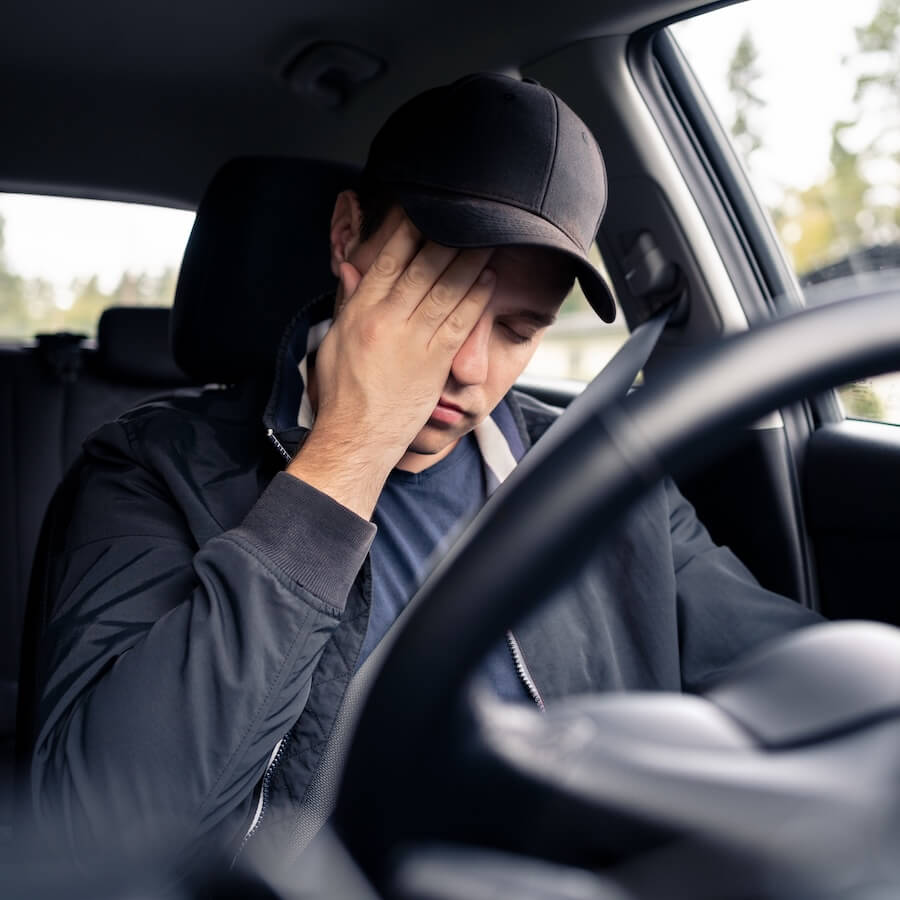
Ask a driver whether they are too tired to drive, and the answer may not be reliable. The National Sleep Foundation (NSF) estimates that 145 million U.S. adult drivers (61%) have driven impaired by sleepiness, according to its 2026 Drowsy Driving Report. Nearly 35 million do so at least monthly.
That scale makes fatigued driving hard for fleets to manage. Crash reports undercount it, and drivers misjudge their own alertness. Fleets can still shape the conditions that produce it: schedules, sleep education, and whether drivers feel safe stopping.
Key Takeaways
- Fatigue leaves little evidence behind, so a fleet’s own records can understate how many of its crashes involved a drowsy driver.
- Fatigue-related crashes tend to be severe, because drivers are less likely to brake or swerve before impact.
- Drivers often can’t tell how alert they are, so their own judgment is an unreliable early warning.
- Even modest sleep loss raises crash risk, and a regular sleep schedule matters as much as total hours of sleep.
- Drivers should stop when they notice trouble focusing, repeated yawning, or drifting from the lane.
- No single measure confirms fatigue, so spotting it takes several signals together, from driver self-reporting to violation records.
Crash Reports Undercount Fatigued Driving
Federal statistics attribute drowsiness to only 1% to 2% of crashes. The AAA Foundation for Traffic Safety found a much higher share by reviewing in-vehicle camera footage of crashes among more than 3,500 monitored drivers. Drowsiness was evident in 8.8% to 9.5% of the crashes it examined, several times the federal estimate.
The gap exists because fatigue leaves little evidence behind. No breathalyzer equivalent exists, and officers can’t measure drowsiness after a crash. Drivers may not admit they were tired, or may not have recognized it. In the most severe crashes, the driver may not survive to say how alert they were.
A fleet’s own crash records can inherit the same blind spot. If few of your crashes are coded as fatigue-related, that may reflect what investigators could see, not what happened behind the wheel.
Fatigue-Related Crashes Tend to Be More Severe
When fatigue is involved, the crash tends to be serious. AAA reports that one-third of crashes involving a drowsy driver result in injuries, and more than 17% of fatal crashes involve fatigue.
Drowsy drivers may not brake or swerve before impact. The AAA Foundation notes that drowsy-driving crashes tend to be severe because the driver may not brake or swerve, so the impact comes at speed. According to SambaSafety’s 2026 Driver Risk Report, that pushes claims toward large bodily injury payouts and total vehicle losses.
That severity carries legal weight. The report notes that plaintiff attorneys use dashcam footage and driver work records to argue that a fatigued driver was unfit to drive.
Why Drivers Can’t Judge Their Own Alertness
About 40% of adult drivers don’t recognize the basic warning signs of drowsy driving, according to NSF’s 2026 report. Frequent blinking, head-nodding, and drifting from the lane are among the signs they miss.
Recognition is only part of the problem. In a 2024 NSF survey, just 50% of adults said they were likely to avoid driving when they hadn’t slept enough. Almost 90% said they would avoid driving after a few drinks. Adults treat sleepiness as a weaker reason to stay off the road than alcohol.
A safety policy that says “don’t drive while fatigued” only works if drivers can tell when they’re drowsy. Fleets need signals that don’t depend on a driver’s self-assessment.
How Little Sleep Loss Raises Crash Risk
A study in the journal Sleep found that even modest sleep loss raises the odds of being at fault for a crash. Drivers who had slept six hours in the previous 24 had 1.3 times the odds of being at fault. The comparison group slept seven to nine hours. The odds rose with each hour lost.
Consistency matters as well as total hours. Discovery Insure, a South African insurer, analyzed four years of linked sleep, telematics, and claims data from more than 10,000 clients. Drivers who kept a regular bedtime were up to 36% less likely to be in a crash than drivers with irregular sleep. Drivers who regularly slept seven to eight hours had up to 32% lower risk than those who regularly slept too little. About half of the link between sleep and crash risk came from sleep debt built up over several consecutive nights, not from one bad night.
For fleets, the pattern points to schedules. A driver who sleeps seven hours tonight can still carry sleep debt from earlier in the week. Start times that change often can make regular sleep harder. Long commutes and remote worksites can also cut into sleep before a shift even begins.
Signs of Fatigue Every Driver Should Be Aware Of
Fatigue shows up in how a driver thinks, reacts, and drives. NSF highlights seven warning signs of drowsy driving that fall into three categories:
Focus and mood
- Difficulty focusing, daydreaming, or wandering eyes
- Trouble remembering the last few miles
- Feeling restless or irritable
Physical reactions
- Yawning repeatedly or rubbing your eyes
- Nodding off or struggling to keep your head up
Driving behavior
- Missing an exit or ignoring traffic signs
- Drifting from your lane, tailgating, hitting a rumble strip, or driving too slowly
Any of these means it’s time to stop somewhere safe and take a break. Opening a window, turning up the music, or eating a snack won’t fix it, because none of them addresses the cause: too little sleep.
Spotting Fatigue Across Your Fleet
Many of these signs are felt by the driver, not seen by a manager. Our 2026 Driver Risk Report notes that there’s no agreed-upon gold standard for measuring fatigue. Fleets get a clearer picture by combining four sources: driver self-reporting, schedule patterns, camera and telematics data, and violation records.
Violations rarely name fatigue, because only two states have laws that address drowsy driving directly. Lane or following-distance citations mirror two of the warning signs listed above and can prompt a coaching conversation to learn more.
Audit Questions for Fleet Leaders
- How would you know today if a driver were too tired to drive? If the answer is that the driver would tell you, the research suggests many wouldn’t recognize it.
- Do your drivers have a regular sleep window? Shifting start times and back-to-back long days make a consistent bedtime difficult.
- Have your drivers been trained to recognize the signs and know what to do? Fatigue-focused driver training gives drivers a shared language and a plan before they’re behind the wheel.
Where to Start
Start with the audit question you couldn’t answer with confidence. Each gap is a place where fatigue can slip past your fleet unnoticed. A written fatigue management policy turns the answers into rules that drivers and managers can follow. It can cover schedules, rest, and what drivers do when they feel tired.
Fatigue is one of the risks a fleet safety program has to cover. SambaSafety’s guide, How to Implement a Comprehensive Driver Safety Program, walks through building a driver safety policy, ongoing training, and intervention strategies.